Beauty as Humanity’s Foundation in an AI-Influenced World
We humans are limited creatures. We don’t run as fast as a cheetah, are not as strong as an elephant, cannot fly on our own like a bird, nor swim as well as a dolphin. This is precisely why we use tools. We design and wield complex technologies to improve our lives, so much so that we have fundamentally reshaped our planet. This capability separates us from other animals.
But why does this matter? I’d argue that in every era, this unique capability has a downside. And especially now, it ironically threatens to reduce our humanity.
The Irony of Technological Progress
We see the massive growth of social interconnection through the internet, yet studies consistently show that loneliness is on the rise. We have access to the largest library of information in history at our fingertips, so why do global-scale famine and poverty persist? Shouldn’t we be wise and smart enough by now to solve our most essential problems? I believe with that potential of knowledge, Leonardo da Vinci would have pillaged a whole town just for a smartphone with an internet connection.
If you think you’re so smart, imagine being transported by a time machine to the medieval ages. Could you explain electricity and computers to the era’s scholars and builders so that they could reinvent them? The honest answer for most of us is no. We are primarily ‘users,’ and even the scientists and engineers among us would need their libraries to achieve such a feat.
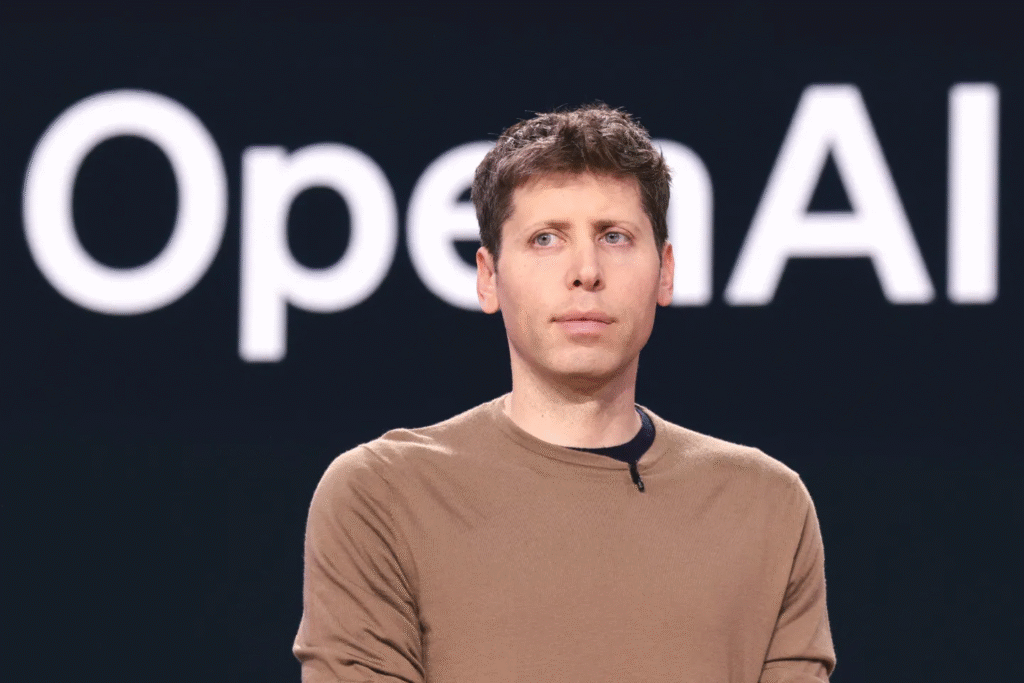
Now, we stand before the rise of LLMs (Large Language Models) like ChatGPT, Gemini, and Claude, alongside countless other accessible AI tools. OpenAI CEO Sam Altman compares competing with AI to trying to “beat a calculator” in arithmetic, urging us to instead leverage it as a tool. He advises that the essential human skills are now “understanding what people want, creative vision, rapid adaptability… and the ability to work with these tools to do much more than people could without them.“
OpenAI CEO Sam Altman
This brings us to the concept of “cognitive offloading”. A paper by Alexandra B. Morrison and Lauren L. Richmond (2020), titled ‘Offloading items from memory: Individual differences in cognitive offloading in a short-term memory task.‘ defines cognitive offloading as: “the act of reducing the mental processing requirements of a task through physical actions like writing down information or storing information on a cell phone or computer. Offloading can lead to improved performance on ongoing tasks with high cognitive demand, such as tasks where multiple pieces of information must be simultaneously maintained.”
Utilizing AI as a method of cognitive offloading is perfectly reasonable. It’s a tool, after all. But where is the line where it stops being our tool and starts replacing us? We know the dystopian tales like The Matrix (1999), where AI and robots exploit humans as energy sources. But look closer and you’ll see we’re already living in a version of that scenario. We’ve begun disregarding our own natural critical thinking, desperately turning to ChatGPT for trivial things we could handle perfectly well ourselves. There’s even a trending meme that jokes about this obsessive dependence, asking AI anything and everything.
Students are overusing LLMs to write entire essays and papers. Some sneak into toilets during exams to get AI to feed them answers, then graduate with diplomas but no actual knowledge and ability to think for themselves. The bare minimum benefit of school used to be that you could at least read, write, maybe memorize the periodic table. You’d come out as a person with base, mediocre knowledge. If you don’t wish to practice those basic things, what’s the point of going to school at all?
And now we can be deceived by images and videos generated by AI. It feels like we’re advancing technologically while simultaneously regressing to an era where we can only verify information through direct meetups or physical evidence. We’re moving forward and backward at the same time. It’s why loneliness persists in an era of interconnection and AI “friends”, why depression is rampant in an era of endless entertainment, and why foolishness endures in an era of accessible information.
This is why need to draw the line to use the tool, not letting the tool uses us.
Where do we draw the line?
This is the question we will explore and for me the strong argument to answer it is beauty, especially our unique capacity to experience beauty and intention to create beauty.
Welcome to the 10th episode of the Everyday Pilgrim Journal (EPJ). To refresh, EPJ explores an idea from the Philokalia—the wisdom of the Church Fathers and the Holy Bible—that we are called to love beauty, and that the ultimate beauty is the person of Christ. This is the great paradox: a poor carpenter from the first-century Levant who, as even secular historians agree, radically changed the world. Those who believe in his words see him as the manifestation of the Creator in human form. Thus, our pilgrimage is to find glimpses of his smile in everything, no matter how small or atomic.
To continue seeking the answer, we must first look at our identity as human beings.
Imago Dei: The Painter and His Painting
The book of Genesis tells us that we are made in God’s image, tasked to “have dominion… over all the earth” (Genesis 1:26). Not as a license for exploitation, but a commission to be creative, cultivating rulers of creation, not passive users of it. We are made to be artists, not just consumers.
This is why we experience beauty in such a mysterious way. It’s why we sense a pull towards the eternal.
He has made everything beautiful in its time. Also, he has put eternity into man’s heart…
Ecclesiastes 3:11
This sense of eternity drives us to do things that are nonsensical for mere survival. To survive, we simply need to eat, sleep, reproduce, and protect ourselves from other animals. Yet we build monuments, ponder poetry, and create altars. We compose music, paint landscapes, and write stories that may outlast our lives. We send machines into space, carve statues from stone, and study the stars as if they hold secrets about ourselves. We have a deep-seated need to leave a mark, to create something that reflects a beauty beyond ourselves.
St. Gregory of Nyssa articulated this beautifully in On the Making of Man (De Hominis Opificio), Chapter 5:
“As then painters transfer human forms to their pictures by the means of certain colors… so that the beauty of the original may be accurately transferred to the likeness, so I would have you understand that our Maker also, painting the portrait to resemble His own beauty, by the addition of virtues, as it were with colors, shows in us His own sovereignty… with such hues as these did the Maker of His own image mark our nature.”
St. Gregory of Nyssa
Our purpose is to be a living portrait of that divine beauty. This is our work. This is what it means to be human.
In Christian philosophical anthropology this is called the Imago Dei, the image of God, as mentioned in Genesis 1:26 above. It’s important because it supports the idea that all people have dignity, this is the moral basis for much of modern law.
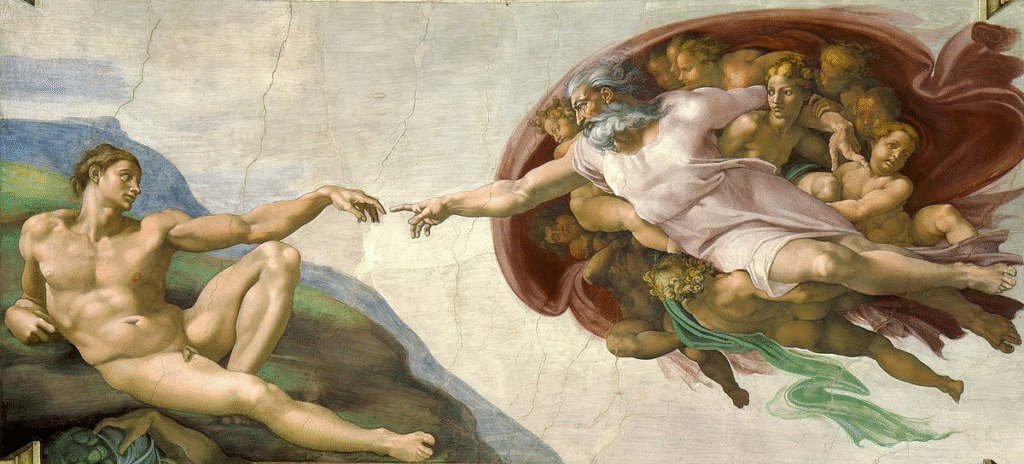
The Creation of Adam by Michelangelo
Historian Iris Chang, in her book The Rape of Nanking, argues that the Holocaust happened in part because Germans were brainwashed to see non-Aryans as less than human, even though they had once been shaped by a Biblical idea of human worth. A similar pattern appeared during Japan’s conquest of Asia and the Nanjing Massacre, where people were taught to dehumanize others.
Because if humans are reduced to mere observable molecules moving around, or “gene machines” as Richard Dawkins said, then it becomes justifiable to commit any cruelty you can think of: violence, plundering, hate, sexual harassment. One might argue, “But the chemical reactions in my brain prevent me from doing cruelty, so these observable molecules are enough for the synthesis of morality and enough to define humanity.”
The problem is that taking faith in the chemical reactions in your brain also affirms the spiritual realm some people claim to have experienced, including the sense that somehow we’re made in the image of our Creator. Look at how unreliable these chemical reactions are. Sometimes one can be stoic, other times temperamental. So to believe that cruelty is wrong, we have to believe there is an objective, unchanging basis for it.
This is why I believe Imago Dei can explain our inherent identity as human beings. We come back to that “eternity” mentioned before. The fact that we can sense eternity is because we’re the product of eternity, and not only a product but its main expression. This is something AI cannot replicate.
We can create AI models that describe a painting or scenery with poetic words after analyzing it, but can it actually feel good because of the beauty of that painting or scenery? That indescribable consciousness is what sets us apart from the most advanced AIs.
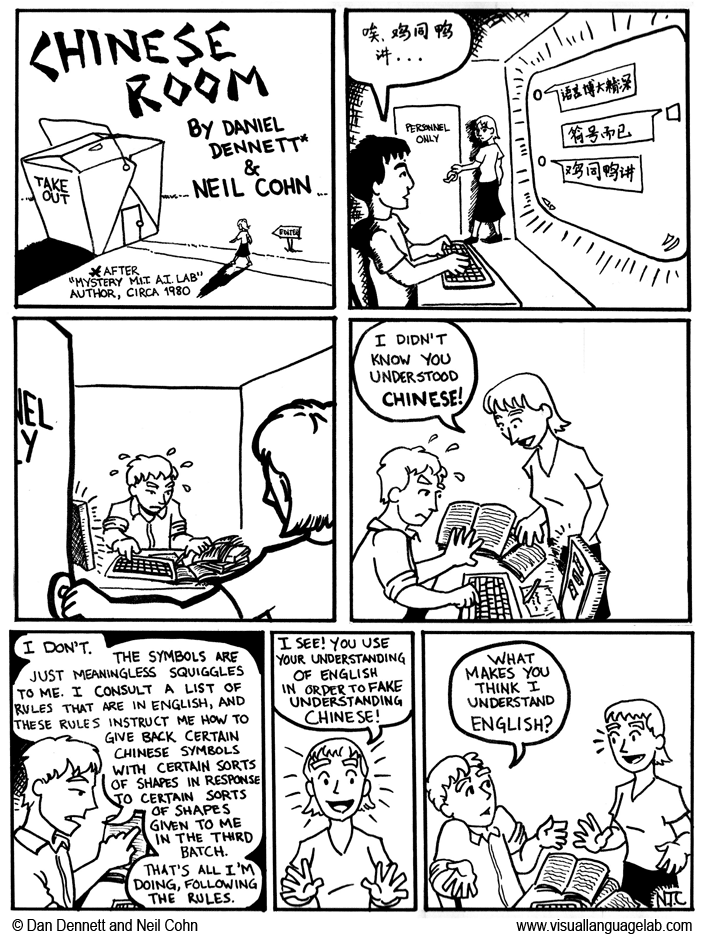
John Searle, with his thought experiment called the Chinese Room Experiment, argues that computation alone can never produce genuine understanding. A person locked in a room could follow instructions to manipulate Chinese symbols and produce correct responses without understanding a single word of Chinese. The person is simply following rules.
A comic depicting the Chinese Room Experiment, illustrated by Dan Dennett and Neil Cohn
Similarly, AI processes symbols according to algorithms but lacks the conscious experience that accompanies human understanding. It can generate the language of appreciation, but it doesn’t know beauty the way we do.
This distinction matters now more than ever. As AI becomes more sophisticated in mimicking human expression, we risk forgetting what makes our responses to beauty real. When an AI writes a poem about a sunset, it arranges words based on patterns. When we write about a sunset, we’re translating an experience that moved something inside us, something that exists because we bear the image of a Creator who first called creation “good.”
One might argue: but isn’t that how we work too? We see patterns from people who wrote poetry, and we also want to express the beauty we feel inside. If you’re thinking along these lines, you’re missing the whole point. What we’re talking about is intention, not ability. Even if someone developed an AI model that automatically creates poetry from its own programmed intention, that original intention still came from humans who love poetry in the first place.
If AI were to truly replace us, it would make more sense for them to become the perfect gene machines the New Atheists proposed. Why would they bother making nonsensical stuff like poetry? The fact that we create AI that can produce art reveals something about us, not about the machines. We’re projecting our own inexplicable drive toward beauty onto our creations because that drive is so fundamental to what we are.
Conclusion
AI’s inability to truly experience beauty isn’t a limitation we should mourn but a reminder we should celebrate. It shows us that no matter how advanced our tools become, the conscious experience of beauty remains uniquely ours, a fingerprint of the divine image we carry. Now that we’re aware of this, let us rejoice and become more mindful in using this sophisticated tool to support our ultimate goal, not letting it use us. We’re the ones who should conquer, and we should not bow down to our own creation.
Use AI where it genuinely serves you, but know the difference between delegating tasks and delegating thought. Revision is repetitive, yes, but it’s also where clarity emerges. Research can be tedious, but it’s where you encounter ideas that challenge your own. The question isn’t whether something feels like work, but whether that work is forming you. Using AI to help organize your research or check your grammar? That’s a tool serving its purpose. Using it to write your entire essay or answer your exam or over-relying on it to never memorize anything? That’s surrendering the very process that builds your capacity to think, learn, and articulate truth.


Leave a Reply