
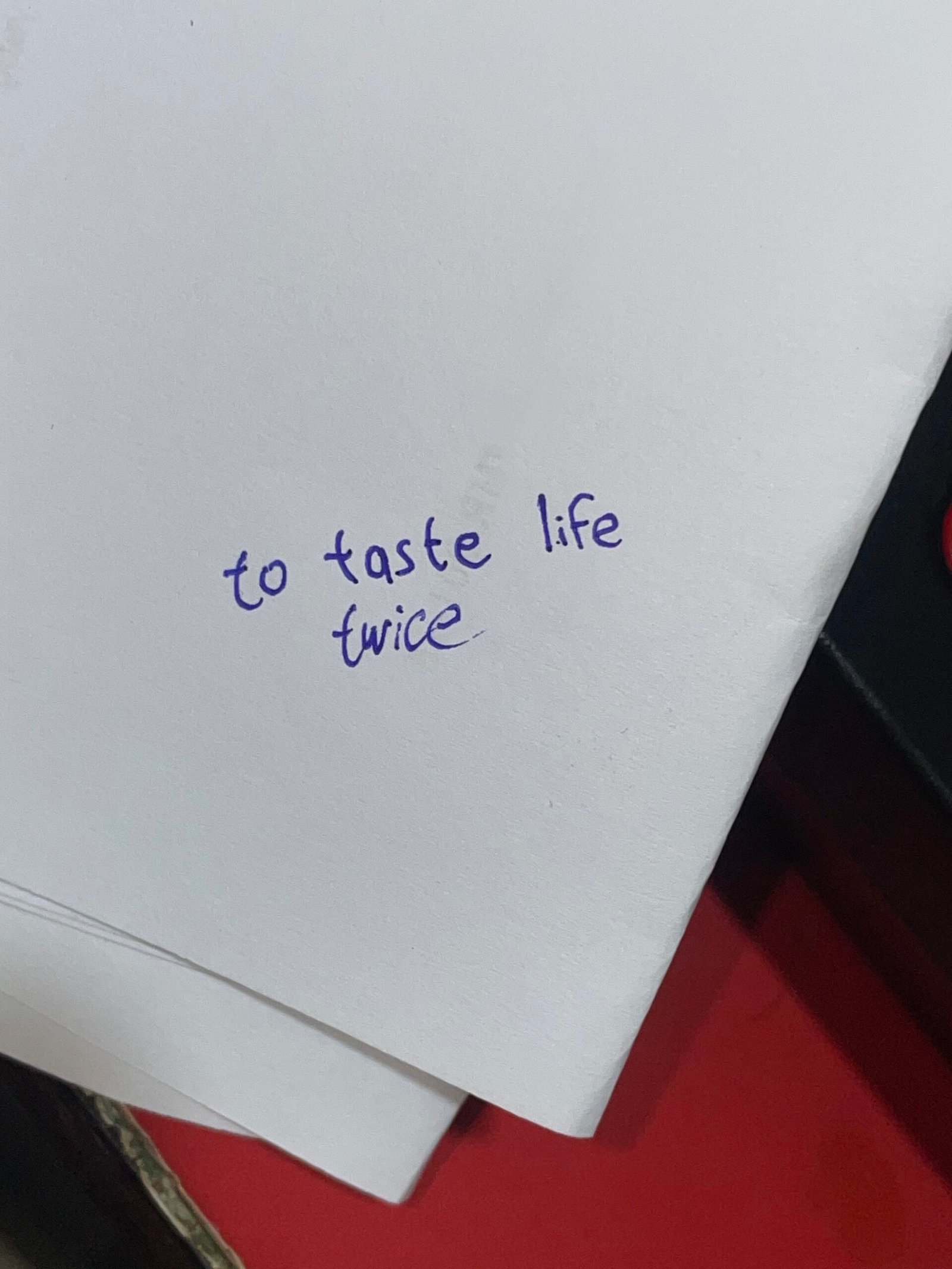
“We write to taste life twice, in the moment and in retrospection. We write, like Proust, to render all of it eternal, and to persuade ourselves that it is eternal.”
— Anaïs Nin
I was diagnosed with hyperactive ADHD back in 2007, long before the doomscroll era. Today, most people around me see someone calm and collected. Behind the scenes, I still fidget, over-explain, and finish other people’s sentences, but I can fairly say I’ve improved a lot. My overthinking and racing mind have eased significantly. I can finally finish tasks and big projects. So how did I get from there to here?
Before answering, it’s worth asking why so many of us struggle to slow down in the first place.
The Problem: A Society in a Rush
ADHD (Attention Deficit Hyperactivity Disorder) is commonly described in two main forms. The inattentive type struggles to sustain focus, follow through, and keep track of things, and often looks dreamy or forgetful rather than restless. The hyperactive type is driven by restlessness and impulsivity such as fidgeting, talking too much, interrupting. I’m the second kind.
But you no longer need a clinical diagnosis to recognize these traits. Young and old, plenty of people today seem to have some form of attention deficiency. The phone is an easy culprit, and it does contribute a lot. A 2026 longitudinal study in Pediatrics Open Science found that social media use, unlike other digital activities, was associated with increased inattention symptoms.
But the bigger picture matters more: modern society is so full of rushing that we’ve lost the ability to immerse ourselves in a moment. The problem is inattention. Rushing causes inattention. Inattention causes us to carry only a shallow impression of everything we encounter.
Byung-Chul Han has a name for what’s happening to us. He argues that we no longer live in a disciplined society built on prohibition that is governed by “don’t”, “shouldn’t”, “must not”, but in an achievement society built on an unlimited can. Nobody has to force us to rush anymore; we drive ourselves, becoming, in his words, entrepreneurs of our own exhaustion. Han says that deep, contemplative attention is what made culture and philosophy possible in the first place. It is being displaced by what he calls hyperattention. Hyperattention is defined as a rapid, scattered shifting between tasks and sources of information that cannot sit still long enough to be bored. And boredom, to him, is not empty time, it’s the mental equivalent of sleep, the resting state from which anything new is actually made. A life spent rushing, he writes, produces nothing new. It only reproduces and accelerates what already exists. In a later book, The Scent of Time, Han pushes this further: our devotion to constant activity has reduced us to animal laborans, laboring animals, stripped of the capacity to linger. Without that capacity, time stops accumulating into something we can hold. It just passes.
Han’s answer to this is to reclaim boredom and contemplation. In this article, I want to push the idea somewhere slightly different in practice. I’m not arguing that we should all stop and do nothing, that’s not realistic, not practical, and for most of us, not even desirable. What I’m after is the clarity that contemplation produces, carried back into action. The goal isn’t less activity and living in laziness. It’s activity that has been thought through rather than merely reacted to.
If you want the fuller case on contemplative life and stillness, I’ve written before about it here [Finding Silence in a Noisy World].
The Opposite of Rushing
The opposite of rushing is not procrastinating or being slow. I’m not telling you to submit your work after the deadline. Not rushing isn’t about doing less or doing it later. It’s about clarity of mind. Sometimes something urgent needs to be addressed quickly, and that’s fine.
I currently live in Jakarta, and compared to where I lived before in East Java, everything here is fast-paced. Everyone is constantly running through the train station, hopping from one train to another. If I don’t keep up with the schedule, I get left behind.
Everything has a rhythm that we need to follow. You’re not a skilled musician if you play your instrument as fast as possible for the sake of mere speed. You’re a skilled musician if you know when to play fast or slow depending on the musical argument you want to convey. That takes clarity.
Life in general demands this same clarity of us, whatever our profession. Anything done in mindless rushing yields undesirable results.
The best tool I’ve found for that is a pen.
“Instructions for living a life:
— Mary Oliver
Pay attention.
Be astonished.
Tell about it.”
Why Write? A Human Answer
Whenever I argue that an activity is good, I start with its philosophical anthropological basis. That’s just a cool term for understanding our identity as humans. And my claim is simple: as human beings, we are gifted with the ability to write. We can take a complex string of thoughts and record it as symbols on paper.
Think about texting. Without speaking a single word, you can send a birthday party date, an idea, or your friend’s darkest secret to someone else. Writing is awesome. It lets us transfer and record ideas for others, and it lets us organize our own thoughts for ourselves, as in personal journaling.
How Writing Lets You Enter a Different Domain of Time
Writing requires you to pay attention. It sounds cheesy to write down your feelings. But when you pause and make the effort to produce a sentence describing your inner self, you’re being honest with yourself. It benefits our lives too, because we can only address a problem that we truly believe exists. By writing it down, you try to capture the immaterial intuition and nuances of your inner senses on paper. It might be imperfect, but by attempting to do so you are one step closer to know yourself better.
Writing it down also formalizes the idea into a sentence. This is the pillar of academia. You become someone who contributes to the pool of human knowledge by writing and publishing your work. That’s also why writing and learning are so tied together. Almost every idea I have that’s useful and worth talking about is an idea I wrote down first.
This is where Anaïs Nin’s line earns its place. Writing lets us taste life twice. Once in the moment, and once in retrospection. In that sense, writing stretches time itself.
Starting: A Few Practices
Let’s start writing. I can’t teach you how to be an award-winning novelist, but every great novelist started by writing down their own observations of whatever they were exposed to. Writing is an exercise, and only by practicing it again and again can we grow more skillful at turning observation into words.
Write it down. Start with a notebook. A personal one that you do not intend to publish. When I was stuck during the COVID lockdown, I discovered bullet journaling. I’ve never completed a serious task or project without first writing it in a notebook or a checklist. By writing my tasks down I got used to finish my tasks one by one without overthinking. I also started to write any kind of feeling or emotion I could perceive.
Change your environment. Nietzsche encouraged us to move because generating ideas only by being idle in your room is dangerous. Thinking also often loosens when the body does. Try to have
Fill your well. To write well, you also need to be empathetic. Read a lot and talk to more people to build your mental vocabulary. If you want to start a reading routine, read the tips here. Again, it’s about being human, after all.
Closing
I improved because I started writing things down. I realized I could not control every moment, but I can meet each one with a little more clarity than the last.
That’s the invitation I want to leave you with, more than any method. You don’t need to overhaul your life or buy a new notebook today. Start smaller with writing one sentence tonight about something you noticed. Just write one honest observation about your day. See what it does to the way you remember it tomorrow.
If a restless mind like mine can learn to slow down enough to notice its own life, yours can too. That’s not a flashy promise. It’s just one I’ve watched come true, one page at a time.
Leave a Reply